
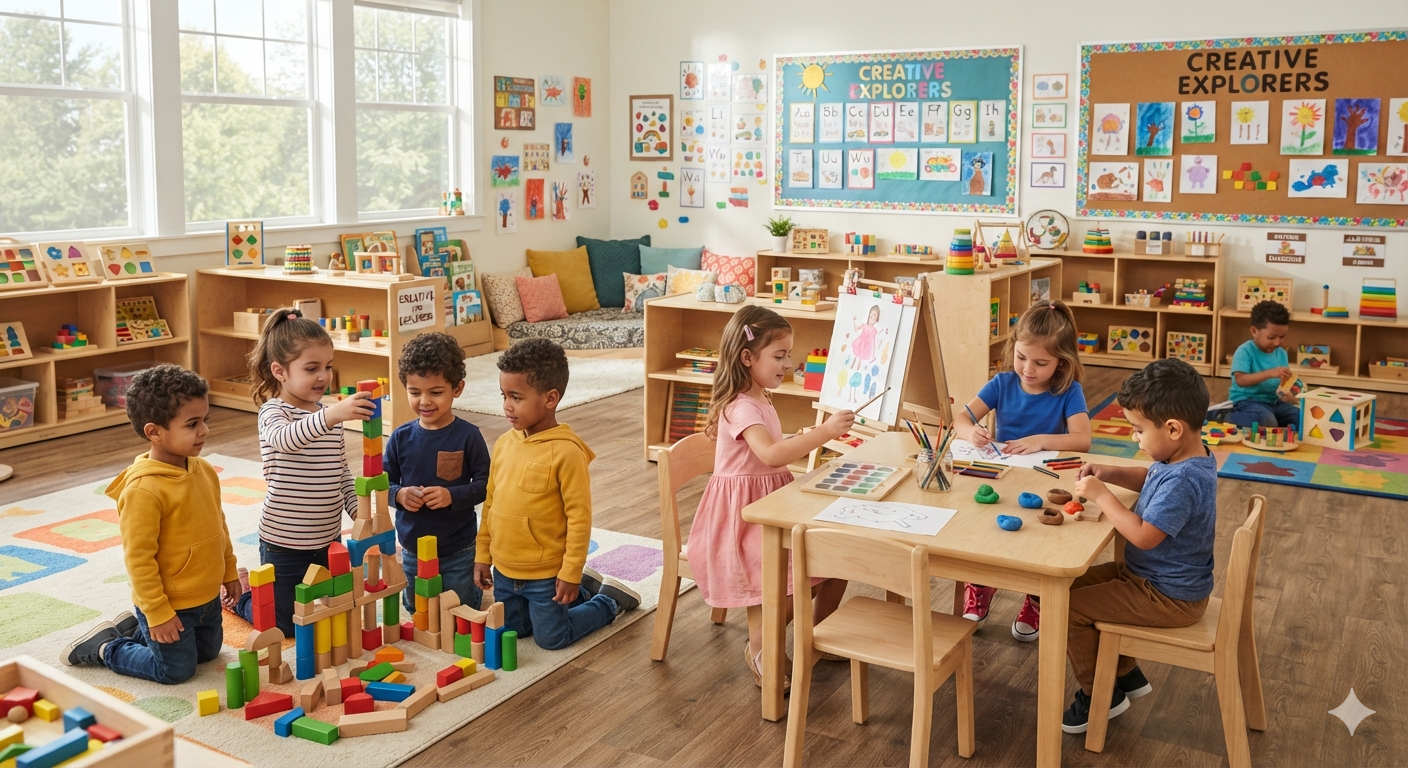
A preschool classroom filled with books, labels, signs and children’s writing may look decorative, but when those materials are placed where children can see, touch and use them, print becomes part of everyday learning.
A print-rich preschool environment is not simply a room covered in alphabet posters. It is a space where written language has a purpose. Children see their names on cubbies, recognize labels on activity areas, browse picture books, make marks on paper and encounter words during play.
For parents evaluating a preschool, the useful question is not, “How much print is on the walls?” It is, “How are children actually interacting with language and written symbols throughout the day?”
What Does “Print-Rich” Actually Mean?
A useful print-rich environment gives children repeated opportunities to discover that printed symbols carry meaning.
Research on early literacy emphasizes the value of print-rich learning environments where children have regular access to books, writing tools, functional signs and opportunities to use print during everyday activities.
Examples include:
- Children’s names beside photographs or belongings
- Labels identifying shelves and activity areas
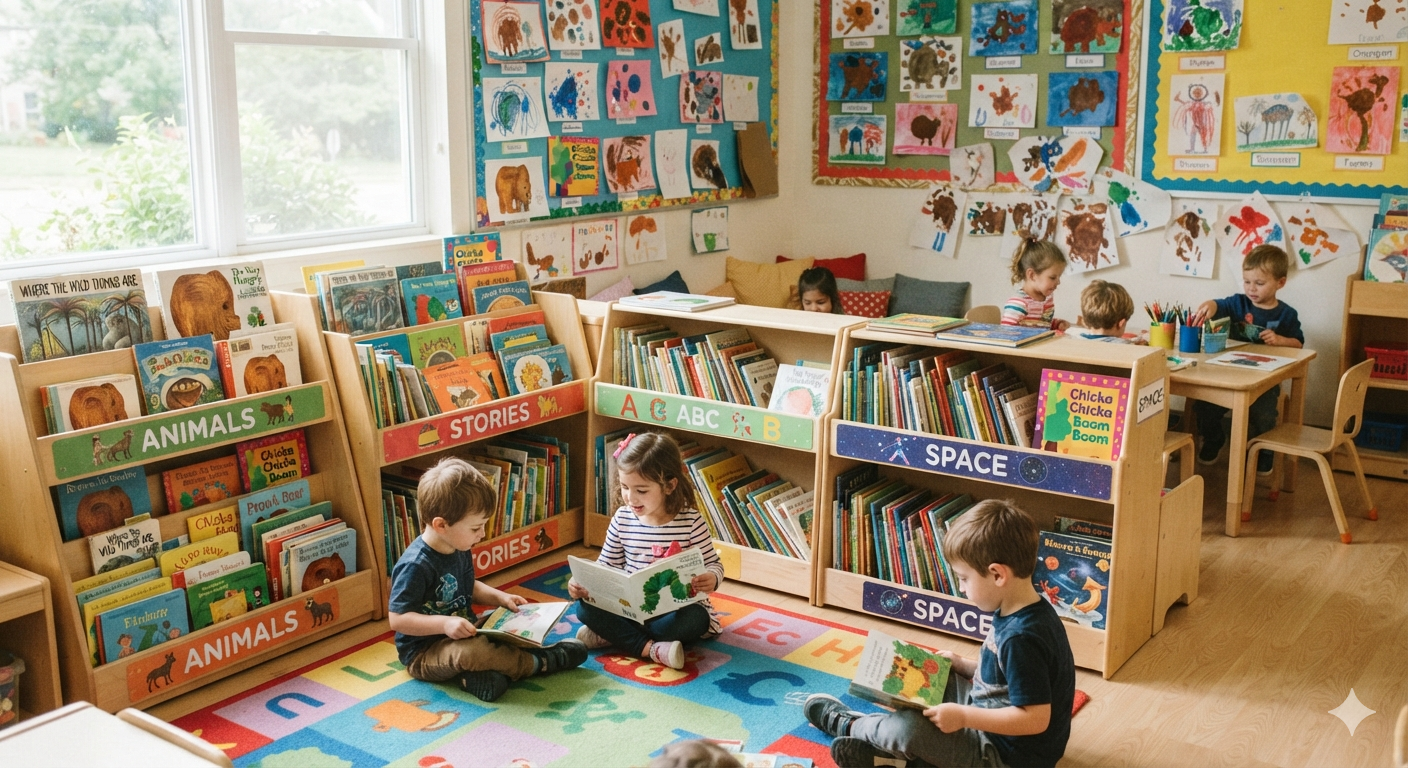
- Picture books within children’s reach
- Menus and signs in pretend-play areas
- Children’s drawings with written descriptions
- Paper and pencils for experimenting with writing
- Simple schedules, maps and classroom signs
The key is meaningful use.
A label reading “Library” beside a classroom book area has an obvious purpose. A wall crowded with unrelated vocabulary cards may offer far less opportunity for interaction.
Interaction Matters More Than Decoration
Children do not learn simply because words are present. Adults help make print meaningful.
Imagine two classrooms with identical labels on their shelves. In one, the labels are decorative. In the other, a teacher asks a child to find the shelf showing the picture and word for “blocks.”
The second interaction connects spoken language, an object, an image and written language.
Books work similarly. Having a bookshelf is useful, but educators add value when they discuss pictures, introduce unfamiliar words, ask questions and invite children to retell parts of a story.
Print Can Become Part of Play
Literacy can be introduced naturally through activities children already enjoy.
A pretend grocery store might include:
- Shopping lists
- Food labels
- Price signs
- Receipts
- Paper and pencils
A child may pretend to write a shopping list while another recognizes the first letter in a familiar product name. Literacy becomes something children use, rather than a separate academic exercise.
NAEYC highlights dramatic play as one setting where reading and writing can be incorporated meaningfully.
For a publishing and printing website such as Metro Print & Publishing Hub, this illustrates an important principle: printed material becomes valuable when people can actively use and understand it.
More Print Is Not Necessarily Better
A print-rich classroom should not be confused with a visually crowded one.
Parents touring a preschool should look for purposeful print rather than simply counting posters.
Consider:
- Can children reach books independently?
- Do labels relate to nearby objects?
- Is children’s own work displayed?
- Are teachers using print during play and conversation?
- Can children draw, scribble and experiment with writing?
- Does the classroom feel organized rather than overwhelming?
A strong environment supports engagement instead of merely looking educational to adults.
Children’s Own Work Matters
Professionally printed learning materials have a role, but they should not replace children’s creations.
Imagine a child drawing a dog and telling a teacher, “My dog runs fast.” The teacher writes that sentence below the picture and reads it back.
That simple interaction connects speech, drawing and written language.
As children develop, they may begin adding marks, letters, names and invented spellings themselves. Print becomes personal because children are contributing to it.
What Parents Should Observe During a Preschool Visit
Websites can help families create a shortlist, but an in-person visit reveals how a classroom actually functions.
When visiting The Vine Learning Center or another early-learning provider, look beyond colorful displays.
Books
Are books accessible throughout the day, or only during scheduled reading periods?
Teacher interaction
Do educators ask questions, introduce new words and listen to children’s ideas?
Play areas
Are writing and reading materials incorporated into imaginative activities?
Children’s work
Do you see drawings, names, stories and projects created by the children?
Age appropriateness
Ask how activities change as children grow. A two-year-old and five-year-old should not be expected to interact with print in exactly the same way.
The CDC emphasizes that developmental expectations change as children grow across areas including learning, communication, play and movement.
Print-Rich Does Not Mean Forcing Early Reading
Providing books, letters and writing opportunities does not mean turning preschool into an elementary-school reading program.
Young children can develop early literacy through storytelling, conversation, songs, drawing and imaginative play.
A preschooler recognizing their printed name is learning about written language. A child pretending to write an order at a play restaurant is exploring the purpose of writing. A child holding a book correctly is learning how books work.
These experiences introduce literacy without requiring children to perform beyond their developmental stage.
Choosing a Local Preschool in San Diego
The classroom environment is only one part of choosing a preschool.
California parents should also consider staffing, supervision, licensing, family communication, safety procedures, outdoor play and how activities change as children develop.
The California Department of Social Services oversees licensed child-care facilities and provides resources families can use when evaluating providers.
Families searching for a local preschool in San Diego can apply these criteria when comparing nearby programs.
The Vine Learning Center describes its approach as play-based with individualized attention, while its locations page identifies its Ulric Street center as providing preschool services in San Diego. Parents should still visit personally, ask questions and decide whether the environment fits their child’s individual needs.
A Simple Test: Is the Print Being Used?
Parents do not need specialist training to evaluate a classroom.
Ask one simple question:
Can you see evidence that children actually use the books, signs, labels, paper and writing materials around them?
Look for well-used books, children’s names on projects, handmade play-area signs, drawings with stories and pencils beside pretend menus.
A strong print-rich environment makes language part of everyday experiences. It allows children to listen, talk, explore books, notice symbols and experiment with writing.
For parents choosing a preschool, the takeaway is simple:
Don’t count the posters—watch how learning happens.
If you are comparing preschool options in San Diego, tour the centers on your shortlist, observe classrooms while children are active, and ask educators how language, reading, writing and play are incorporated throughout the day.